|
|
Additional Reference Information on
Corrections
|
|
Google Search Facility
Additional Site Navigation
Bookmarks for this Page
Indigenous people and the prison
ACT Community Coalition on Corrections
Australian Institute of Criminology
Australian Bureau of Statistics
Winnunga Nimmityjah Aboriginal Health Service
International Centre for Prison Studies
National Institute of Corrections, Information Center of the U.S. Department of Justice
Canadian Association of Elizabeth Fry Societies
Date page last updated 02-Mar-2011
Number of page visitors
|
References to Information on Corrections
Senate, Select Committee on Mental Health, A national approach to mental health: from crisis to community, First report (March 2006). This very important Senate report has a broad focus on the many problems associated with how mental health is handled in Australia. Of particular relevance are chapter 13 on mental health and the criminal justice system and chapter 14 on dual diagnosis as ’the expectation not the exception’.
ACT Community Coalition on Corrections, Healthy or harmful? Mental health and the operational regime of the new ACT prison (ACT Community Coalition on Corrections, Canberra, April 2008).
This
study makes the point that mental health requires an operational regime
that does not impose unhealthy stresses on those detained. Such stress
aggravate and even cause mental illness of those detained. Mental health
is, thus, not achieved in prisons simply by providing good mental health
treatment. Stresses common in the traditional prison system include long
periods of seclusion, strip searching, boredom and lack of family and
other support. Nor is it sufficient to attend to the conditions in the
prison. The capacity of people with mental health problems must be
strengthened to enable them to resume their place in the community. The
need for this is reflected in the very high rates of death by suicide and
overdose in the weeks following release.
Mental Health Council of Australia, Not For Service: Experiences of Injustice and Despair in Mental Health Care in Australia. A report of the consultations by the Mental Health Council of Australia and the Brain and Mind Research Institute in association with the Human Rights and Equal Opportunity Commission (Mental Health Council of Australia, Canberra, 2005). Like the Senate report, this report has a lot to say on the experience of people with a mental illnesses in the criminal justice system including prison. It includes Australia wide testimony of many mental health consumers and carers.
Restorative justice is a broad term that includes any practices that seek to heal the impact of offending and make things right for victims, offenders and their respective communities.
Peter Norden SJ, Restorative justice: A new vision for criminal justice. “Australians generally need to make a cultural shift from an ideology that mistakenly thinks of imprisonment as a simple solution to many of the complex social problems confronting our society today: problems such as homelessness, family breakdown, child and sexual abuse, unemployment, intellectual disability, alcohol and drug addiction, and mental illness, all of which significantly underlie much individual criminal activity.” Mark Griffiths, Strategies to promote the social movement of restorative justice in corrections
Indigenous people and the
prison There is much material about the new prison (the Alexander Maconochie Centre (AMC)) in the publications section of the ACT Corrections website. This includes the statement of the Chief Minister, Jon Stanhope, to the Legislative Assembly in August 2004 set out the Government’s objectives for the prison. This is reproduced at the back of the Communication Plan April 2007.
Office for Children, Youth and Family Support The Office for Children, Youth and Family Support of the Department of Disability, Housing and Community Services is responsible for youth detention. The ACT is building a new youth detention centre as well as a new adult prison:
Overwhelmingly, those sent to present have mental health and other health problem. The Department of Health is has responsibility for the provision of health services within adult and juvenile detention centres. The plans for the delivery of these services are available here and here.
The Commission carried out a Human Rights Audit of Quamby Youth Detention Centre. This the Government’s response of August 2005 to that report. The Human Rights Audit on the Operation of ACT Correctional Facilities under Corrections Legislation July 2007
Standing Committee on Community Services and Social Equity The forgotten victims of crime: families of offenders and their silent sentence June 2004 report.
ACT Community Coalition on Corrections The ACT Community Coalition on Corrections is a coalition of organisations and individuals that have an interest in corrections and particularly in the new ACT prison (the Alexander Maconochie Centre (AMC)), its operation and its performance. Its website includes submissions to and correspondence with government and links to other web sites.
Australian Institute of Criminology This website contains a lot of material on offending and corrections. Examples include:
Australian Bureau of Statistics The Bureau of Statistics publishes regular reports of numbers and imprisonment rates around Australia at their webpage on the National Centre for Crime and Justice Statistics.
Winnunga Nimmityjah Aboriginal Health Service Provides best practice and holistic health services particularly to Aboriginal and Torres Strait Islander people living in Canberra and the region. It published an important report in June 2007 in a best practice model of holistic health service delivery for Aboriginal and Torres Strait Islander inmates of the ACT prison
International Centre for Prison Studies The website of the International Centre for Prison Studies at King’s College, London contains a wealth of challenging material including the following:
The reason for a “commitment to a sparing use of prison lies in the substantial financial, social and ethical costs involved in locking up increasing proportions of the population. What is true all over the world is that people in prison are not representative of society as a whole. They are disproportionately drawn from certain poor neighbourhoods where a range of social, health and community problems are concentrated. This reflects in part the fact that people who are economically and socially marginalised are at greatest risk of being drawn into criminal behaviour and in part the way the police and other law enforcement agencies tend to concentrate their efforts on these areas.” He mentions a ten point plan for criminal justice reform. “The first point is to develop Restorative Justice (RJ). RJ – particularly restorative conferencing – involves victims and offenders meeting face-to-face in the presence of a facilitator. Recent evaluations have shown that restorative conferences and victim/offender meetings bring real and tangible benefits to victims: less anger and anxiety, less Post Traumatic Stress Disorder, and lower health costs.”
National Institute of Corrections, Information Center of the U.S. Department of Justice Provision of mental health care in prisons (February 2001) This is a study of the extent to which corrections agencies in the United States acknowledge the needs of, and provide for mental health care for, not only their acutely or severely mental ill inmates, but also those with lower level disturbance. “It is evident that most U.S. prison populations include significant numbers of inmates who enter the system with mental health needs. Some of these inmates must be housed and cared for separately for short or long periods, while others function acceptably in the general population. An inmate’s previously recognized mental health issues may be exacerbated in the stressful environment of the prison, or an inmate may first be diagnosed with a mental health problem while incarcerated.”
Canadian Association of Elizabeth Fry Societies The Canadian Association of Elizabeth Fry Societies (CAEFS) ( is a federation of twenty-three autonomous societies. All local societies are community-based groups dedicated to the provision of programs and services with and for women and girls involved in the criminal justice system.
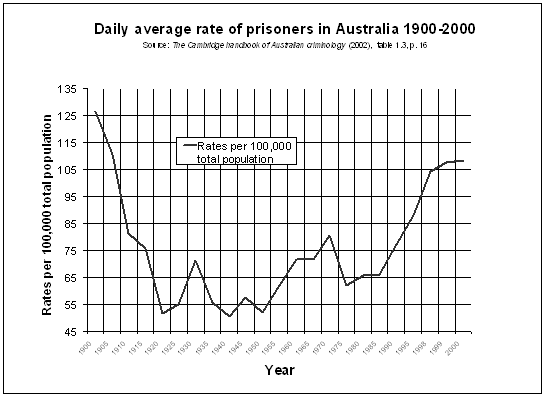
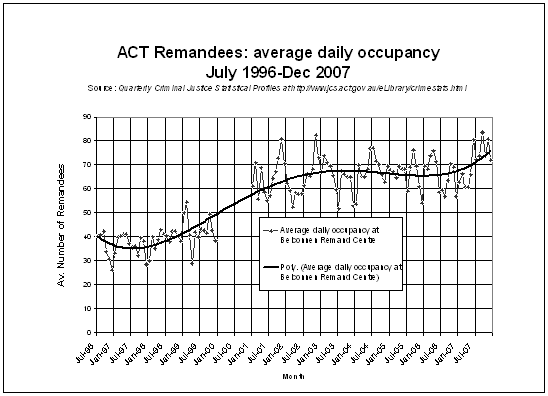
Some general Australian statistics:
Information Resource Booklet All of the above information contained on this page can be downloaded as a small booklet for subsequent distribution.
|