|
|
"How
the ACT compares - facts and figures in Australia" Text of speech delivered at the second CES Forum on the new ACT Prison
|
|
Google Search Facility
Additional Site Navigation
Bookmarks for this Page
Date page last updated 02-Mar-2011
Number of page visitors
|
"How the ACT compares – facts and figures in Australia"
Presented in Canberra on 19 March 2008 at a forum conducted by Christians for an Ethical Society
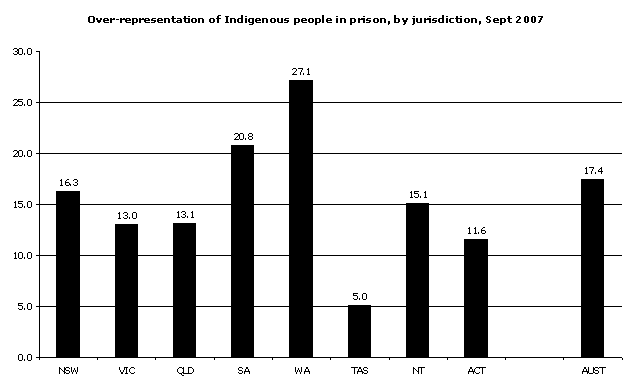
My task tonight is to give you some background or context or perspective of how the ACT prison fits into the national Australian scene in relation to prisons. For the first ten minutes or so, I’m going to give you some basic facts about Australian corrections. Four main trends in prison populations and treatment We are faced in Australia with an astounding period of ever-increasing prisoner numbers. The total number of prisoners in Australia from 1984 to 2007, based on daily averages for each year and, therefore, fairly robust, have increased from below 9,500 prisoners in the whole of Australia to 26,500 prisoners in the 24-year period. That’s a massive increase and an increase way, way ahead of the increase in population. It is, however, the sort of situation one finds in just about every other nation in the western world - prison populations increasing much faster than the population. During that period, over the last 24 years (1984-2007), there have been a number of significant changes in Australian prisons. The total number of prisoners has increased to 26,500 but, over this period, the imprisonment rate, that is the number of persons in prison anywhere in Australia per 100,000 adults, has increased from 83 to 164. That is a doubling of the use of imprisonment over that period of time. Within that group of people, there are some massive changes and the first one - that is much talked about but nothing very effective has been done about it - is in relation to indigenous prisoners. At the beginning of that period, they constituted about 10% of all prisoners, now they constitute 24.4%; that is just about exactly one-quarter of all prisoners in Australia are indigenous. They come from a segment of the population which is only 1.8% of the total adult population of Australia. This level of over-representation of indigenous people in our prisons is a matter of shame, a matter of embarrassment and a matter of international criticism of this country. The second major issue of particular interest is that of women prisoners. In 1984, there were only 2.5% of all persons in prison who were female. That is now 7.5% in the period of 24 years. If we extrapolate from those figures, by the year 2020, 10% of all our prisoners will be female and that is much higher than most countries in the world. In the United States at the present time, it is only 9.1% which is still very high. The third particular point I want to mention does not affect the ACT directly at this time and it relates to private prisons. Up until 1990, there were no private prisons in Australia but the numbers have increased dramatically. All mainland states have at least one private prison and, in fact, between 17 and 18% of all prisoners in Australia now are being held in private prisons. We are - and very few people seem to realise this – we are the most prison-privatised country in the world. That figure of 17-18% is much higher than any other country in the world. It is twice as high as the next highest country which is the United Kingdom and that is twice as high as the United States which has about 3 or 4% of all their prisoners in private prisons. The fourth point I want to mention is that of therapeutic programs. I do not have any hard data to mention this but think I should devote a few seconds to it. All major prisons in Australia now have very professional programs aimed at reducing criminality for those people who are about to leave: programs such as sex-offender treatment, intensive drug treatment, programs with names like ‘cognitive skills’ and so on. There is a need for much improved evaluation of these programs but such evaluation that has been done shows that they are effective in reducing redicivism. For example, a meta-analysis of United States and Canadian studies of sex-offender treatment, shows that people undergoing treatment in prisons have reduced their recidivism from around 30% to around 12%. There is no perfect solution for any of these problems but that saving of around 8% more than pays for the costs of those sorts of programs. Another important aspect applying to all of Australia is remand prisoners, people who are not convicted of any crimes but who have been charged with offences and are awaiting trial. In this jurisdiction, they are the ones who are sent to Belconnen or the Symonston Remand Centre. When this data-collection period started in 1984, remandees or unconvicted prisoners constituted around 10% of all persons in prison; it is now 23.3%. I shall be saying more about those people in a little while.
Over-representation of aboriginal Australians I mentioned that I wanted to say a few more words about aboriginal imprisonment. There’s great confusion in some people’s minds about: How bad is it? How over-represented are they? To calculate the relative level of over-representation of indigenous or aboriginal people in all Australian jurisdictions, three things have to be done: First of all, calculate the indigenous imprisonment rate, that is, the number of indigenous persons in prison per 100,000 indigenous adults in the community. That gives you a figure of 2,200, which means that more than 2% of all aboriginal adults in this country are in prison at any one time. The second thing you have to do is work out the non-indigenous imprisonment rate – the number of non-indigenous prisoners per 100,000 of non-indigenous adults in the community and that gives us a figure of about 126. Now divide the smaller one into the larger and that gives a ‘rate ratio’ of 17.4. That’s telling us that any aboriginal adult person is 17.4 times more likely to be in prison than a non-indigenous person. We are not with the angels here; in the ACT, the figure is 11.6 and Tasmania has a lower aboriginal over-representation rate than we do. That’s probably sufficient by way of a general introduction. I now want to lead into the issues relating to the ACT and the first of these is a critically important one. ACT relative prison populations: convicted and remand
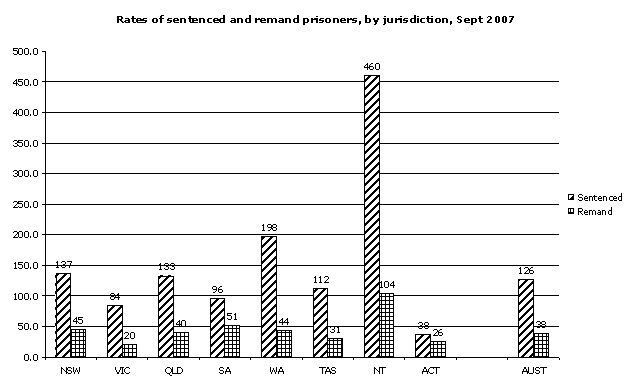
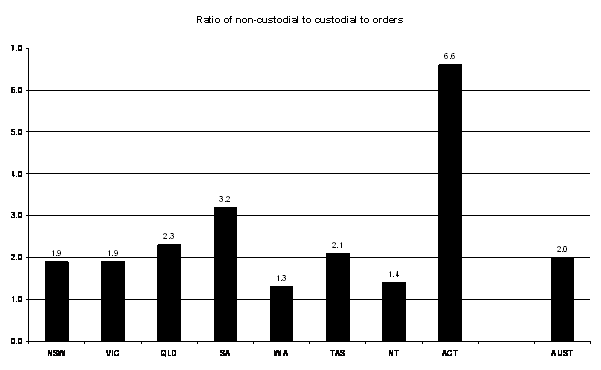
In the ACT, our imprisonment rate is extraordinarily low. It is, in fact, 68 per 100,000 compared with a national imprisonment rate of 164. The underlying question that I want to grope towards in this presentation is whether that is sustainable. I fervently hope that it is sustainable because I believe that we should keep the lowest number of people behind bars that is compatible with public safety. That figure of 68 is phenomenally low and the next lowest is Victoria with 104. The highest is the NT but there are particular reasons for that. The NT has well over 25% of the underlying population are aboriginal and it is well-known that aboriginal people are grossly over-represented. There is a hint in the data which suggests to me that things may not be as easy as we believe. Any imprisonment rate is compiled of two factors which are added. One is the number of persons serving prison sentences who are convicted prisoners and the other element are remand prisoners, those who are awaiting trial. We can add the two together and it should come to the same total. Here I’ve taken them apart. From each one of these, for each jurisdiction, e.g. in NSW, the sentenced prisoner rate is 137 per 100,000 adults and the remand rate is 45 per 100,000 adults. The Australian averages are 126 for the sentenced imprisonment rate for Australia and for remandees, it is 38. I want to draw your attention to the difference between the two ACT rates and the two national rates. These figures are based on the actual number of prisoners sentenced or remanded in custody for the first day of the month. They are not based on daily averages so there is not an exact fit with the figures on the previous table but they are very close. As you know, convicted prisoners from the ACT serve their sentences in NSW but they are still counted as ACT prisoners. In fact, the ABS goes to great trouble to identify those who are ACT prisoners and there are about 100 of those at any one time. Where you are born is irrelevant; it’s where the offence and the action is taken. If one looks at that 26 per 100,000 for the ACT remand rate, it is not so very far below the national remand rate of 38 per 100,000. It’s about 67% as high, which suggests to me that judges and magistrates in the ACT have not been totally averse to using remand imprisonment. When we look at the convicted numbers - 38 per 100,000 for the ACT against a national average of 126, we see that’s where we’ve had our big saving; that’s where our numbers come down - because of that difference. If we had a convicted sentenced prisoner rate which was as close to the national average as we have for the remand rate, that would give us another 219 prisoners. Future trends in ACT sentencing Hopefully, it won’t happen but that difference suggests to me that there is this inhibiting factor which applies to judges and magistrates quite properly in their sentencing. This is my hypothesis, if you like. It seems to me that the only way you can explain that disinclination by judges and magistrates to send people to prison compared with the lack of disinclination to send people to prison for remand can be explained by the fact that the offender and the offender’s family will be seriously hurt by the fact that the person is going to be transported or transferred to NSW. Visiting will be difficult. The person will go from Canberra to Goulburn, from Goulburn to Long Bay and may end up in any of the 17 or 18 prisons in NSW and we have even had cases of ACT prisoners serving their sentences in Grafton. If your husband was in gaol in Grafton, then visiting would be extraordinarily difficult. My hypothesis must lead to the conclusion that, once we’ve stopped transportation, that inhibiting factor won’t be so powerful and, therefore, there may well be an increase in the use of sentences of imprisonment from the ACT judiciary. I hope that’s not the case but that evidence, it seems to me, only points in that one direction. As I mentioned, in September last year, there were close to 26,500 people in prison in Australia. At the same time, there were 53,000 people in Australia convicted but serving sentences in the community. These are people on probation orders, parole, community service orders and the like. If you put that together, 53,000 and 26,500, there are two people who are convicted but serving corrections orders - not in gaol, out there in the community - for every one behind bars. That’s a ratio of one prisoner for every two in the community. When we look around the rest of Australia we find that is pretty much the case with some exceptions. One exception is particularly relevant to us.
Here are the actual figures: for NSW, that ratio is 1.9, for Victoria it’s 1.9 and it goes up a bit for Queensland, a bit down for Western Australia but our figure for the ACT at that time was 6.6. We have more than 1,000 people in the ACT serving non-custodial orders, much higher than any other state in Australia. The only two which don’t conform at the other end are Western Australia and the Northern Territory, where the figures are closer to 1:1. Again, the question arises of whether it is sustainable for that situation to continue. The slightest change to that ratio will mean a blow-out in the number of prisoners. Let me conclude by saying that judges and magistrates are totally independent in their decision-making. No government in a democracy can give directions to the judiciary in individual cases. It should not be offensive to the judiciary, however, if the community said in a clear voice that prison sentences should only be imposed as a last resort. That is, after all, exactly what the Royal Commission into Aboriginal Deaths in Custody said seventeen years ago. It’s also one of the main points made by Professor Tony Vinson in the first seminar of this series. I believe that a sensible conclusion for these brief remarks would be to ask for very careful monitoring of ACT future prison numbers. I think that is absolutely essential, especially keeping under observation the numbers and the rates of sentenced and remand prisoners and the ratio of prisoners to offenders under community corrections orders. My best guess is that it’s rather too optimistic to suggest that our prison with 300 places will be big enough to meet the needs of the ACT for twenty to thirty years. I seriously suggest that a period of five-to-ten years might be more realistic but I fervently hope that I am wrong and that prison numbers will remain in the ACT at the low levels that |